
Each quarter, the Australian Energy Market Operator (AEMO) release their Quarterly Energy Dynamics (QED) report providing a detailed overview of the energy market. This article outlines the key insights from the recent Q2 2026 report, including the primary factors driving electricity and gas prices in the National Electricity Market (NEM) and Western Australia.
Electricity Demand Continues to Evolve
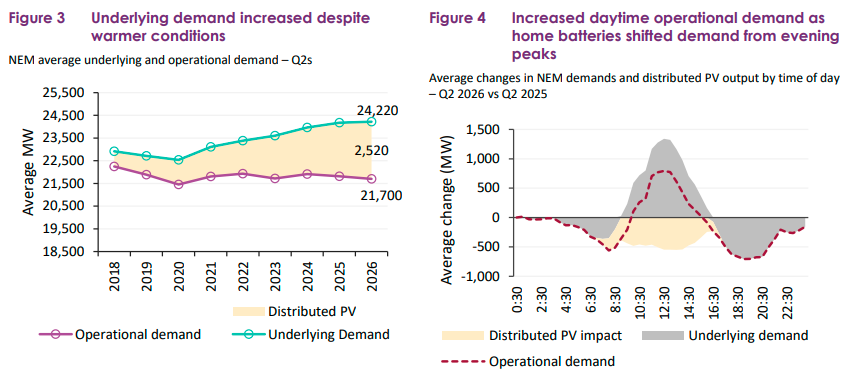
- Underlying NEM electricity demand remained stable, increasing by 0.2% year-on-year to an average of 24,220 MW.
- Continued growth in distributed solar generation (+6.9%) reduced operational demand by 0.5% despite steady underlying consumption.
- Demand profiles continued to shift, with stronger daytime consumption driven by battery charging, industrial activity and expanding data centre loads.
- Reduced evening demand reflected increased household battery discharge and milder winter conditions lowering heating requirements.
- Consumer energy resources continue to reshape load profiles, reducing traditional evening peaks.
- Underlying demand is the total electricity consumed by all users, while operational demand is the portion of that total met by the main power grid. Operational demand subtracts out local rooftop solar and small embedded generators because those systems reduce how much power needs to come from the main grid.
Renewable Generation Reached New Q2 Highs
- Renewable energy supplied a record 42.1% of NEM generation, up from 37.1% in Q2 2025.
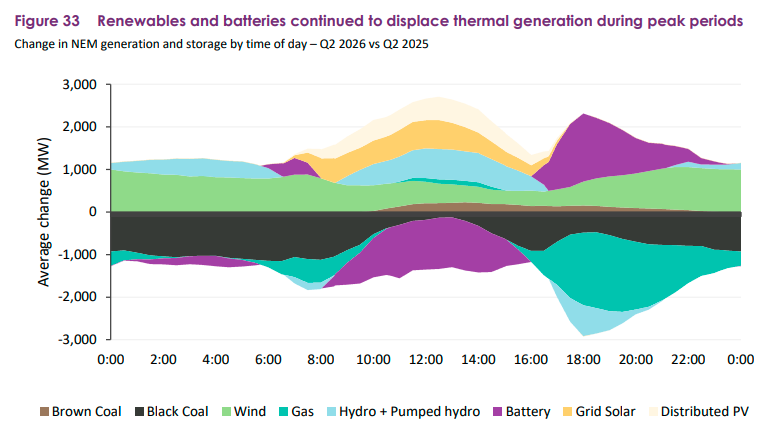
- Wind generation reached a new Q2 record, increasing 20% year-on-year, supported by new capacity and improved wind conditions.
- Queensland recorded the strongest growth, with wind output rising 80% to a new all-time high.
- Grid-scale solar generation increased 12%, with new projects offsetting lower solar irradiance across southern regions.
- Coal-fired generation declined to its lowest Q2 level on record, while gas-fired generation fell to its lowest Q2 average since 2003.
- The cleaner generation mix reduced total NEM emissions by 6.4% and emissions intensity by 6.0%.
Battery Storage Continues to Transform Market Operations
- Grid-scale battery capacity continued to expand, significantly increasing energy shifting between daytime solar generation and evening demand.
- Daytime battery charging increased 211%, while evening discharge increased 228% compared with Q2 2025.
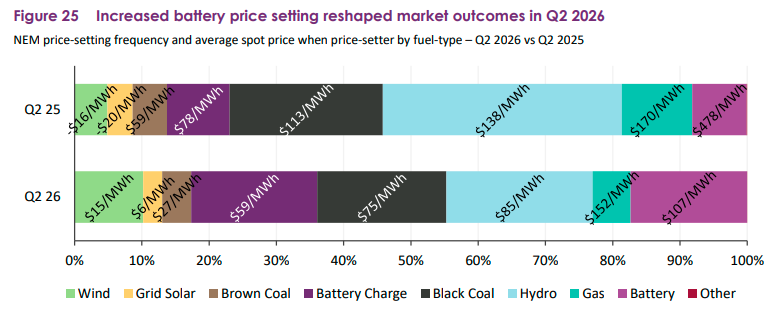
- Batteries increasingly influenced wholesale market outcomes, setting prices in 36% of dispatch intervals, up from 17% a year earlier.
- The greatest increase in battery price-setting influence occurred in New South Wales and Queensland.
- Battery storage is increasingly reducing peak pricing pressure while supporting greater renewable integration.
Wholesale Electricity Prices Declined Across the NEM
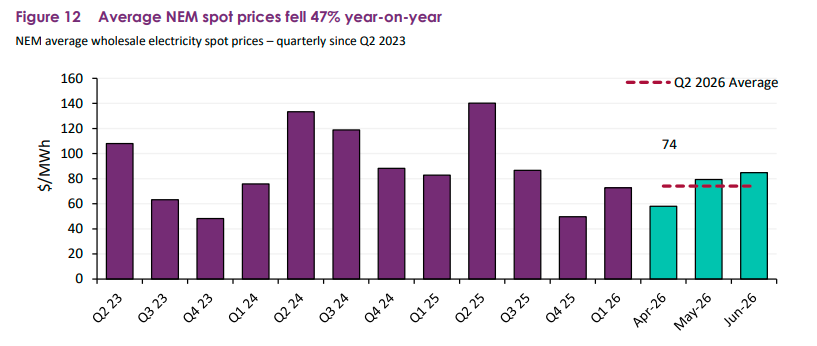
- Average NEM wholesale electricity prices fell to $74/MWh, down 47% year-on-year and the lowest Q2 average since 2020.
- Increased renewable generation, higher battery discharge and reduced evening peak demand collectively lowered wholesale prices.
- Victoria recorded the lowest regional average price at $56/MWh, followed by Queensland ($67/MWh), New South Wales ($75/MWh) and Tasmania ($86/MWh).
- South Australia remained the only region to experience material price volatility, driven by low wind conditions, higher demand and transmission constraints during late June.
- Overall, wholesale price volatility was substantially lower than the previous year.
East Coast Gas Market Softened Despite Global Supply Risks
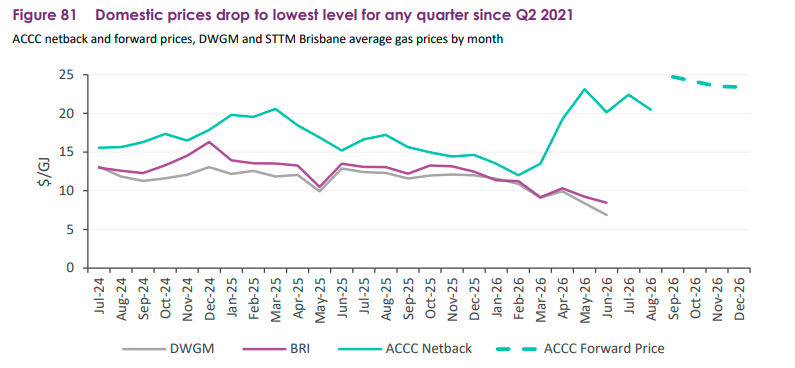
- East coast wholesale gas prices averaged $9.08/GJ, the lowest quarterly average since Q2 2021.
- Domestic gas demand declined 3%, driven by reduced gas-fired generation and lower commercial, industrial and residential consumption.
- Above-average temperatures further reduced winter heating demand, particularly across Victoria.
- Queensland LNG exports reached a new Q2 record despite softer domestic demand.
- International LNG prices remained materially higher than domestic prices due to ongoing geopolitical supply risks in the Middle East.
- Iona Underground Gas Storage remained near full capacity for most of the quarter, highlighting comfortable domestic supply conditions.
Western Australia Experienced Tighter Electricity Market Conditions
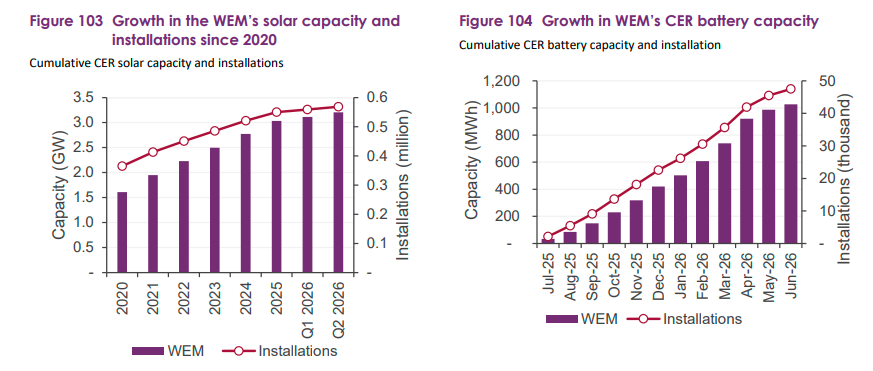
- Underlying demand in the Wholesale Electricity Market (WEM) increased as cooler weather lifted heating requirements.
- Lower wind generation and reduced coal availability increased reliance on gas-fired generation.
- Renewable generation’s share of the WEM declined from 33.6% to 32.0%.
- Average WEM energy prices increased 30% year-on-year to a record $117.87/MWh.
- Higher energy costs were primarily driven by reduced renewable and coal generation combined with increased gas generation.
- Despite higher energy prices, battery participation significantly reduced Essential System Services (ESS) costs through increased competition.
Western Australian Gas Market Remained Well Supplied Despite Lower Activity
- Domestic gas consumption and production both declined 8.5% year-on-year.
- Lower industrial demand contributed to softer overall gas consumption.
- Storage withdrawals remained relatively modest compared with the previous year.
- Pipeline maintenance and cyclone recovery works created intermittent operational constraints across the Dampier to Bunbury Natural Gas Pipeline.
- Despite these operational challenges, domestic gas supply remained adequate throughout the quarter.
If you’d like to discuss your energy contract with one of our experts, simply get in touch via our website.