
For years now, batteries have sat in that familiar category of promising technologies. Full of potential, endlessly discussed, but rarely investable for most businesses.
The concept has always made sense: Store cheap energy during the day; Use it when prices spike on the spot market; Reduce peaks; Add resilience.
Over the past year, a combination of falling battery costs, expanding market revenue streams and new government incentives has quietly transformed the commercial battery landscape. What was once a nice idea is increasingly becoming a serious financial asset for large energy users across Australia.
In this post, we’ll walk through the business case for commercial batteries. The benefits, the costs, and why the economics work now.
Benefits
Batteries are often sold as a single solution, but in reality, they are more like a financial tool with multiple levers.
Pull one lever and you reduce demand peaks.
Pull another and you trade the wholesale market.
Pull a third and you buy insurance against outages.
You can’t usually maximise all of them at once. The real value comes from understanding how each operating mode works and how to combine them intelligently.
At a high level, there are five main ways commercial batteries create value.
(Be sure to register for our upcoming webinar to learn all the details and to have all your questions answered about commercial battery systems!)
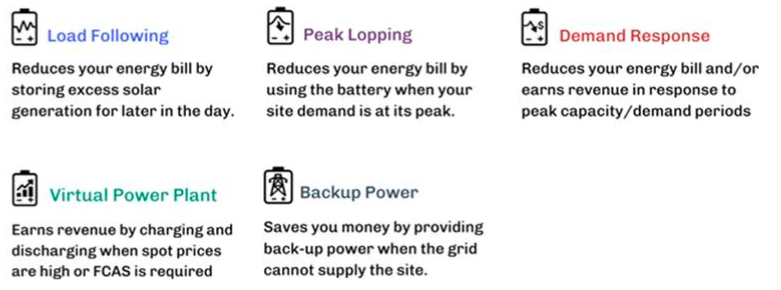

1 & 2 – Load Following and Peak Lopping
This is the traditional battery story.
Charge when demand is low or solar is abundant. Discharge when usage spikes. Smooth out the load profile and reduce network peak demand charges.
It works well in residential settings and for smaller businesses with high retail tariffs and plenty of excess solar.
For large energy users, though, the maths is less compelling.
On its own, peak shaving rarely delivers the returns needed to justify the capital investment.
3 & 4 – Virtual Power Plants and Demand Response
This is where batteries start behaving less like infrastructure and more like financial assets.
Through Virtual Power Plant programs, batteries can participate directly in the wholesale electricity market. They can charge when prices collapse, sometimes even going negative and discharging when the market tightens and prices spike.
Those spikes can reach extraordinary levels, tens of dollars per kilowatt-hour, not cents.
On top of that come additional revenue streams such as FCAS, which pay batteries to stabilise the grid.
Demand response works in a similar way, driven by market signals such as Western Australia’s Reserve Capacity Mechanism.
These events don’t happen every day, but when they do, they are where a large portion of battery revenue is generated.
5 – Back-Up Power
Then there’s the simplest benefit of all: keeping the lights on.
For some businesses, a short outage is an inconvenience.
For others, it’s lost production, damaged equipment, missed deadlines and real financial pain.
A battery providing even 30 minutes of back-up power can quietly save thousands of dollars when it matters most often while still earning revenue the rest of the year.
Costs
Batteries are getting cheaper
This is the part that’s changed fastest.
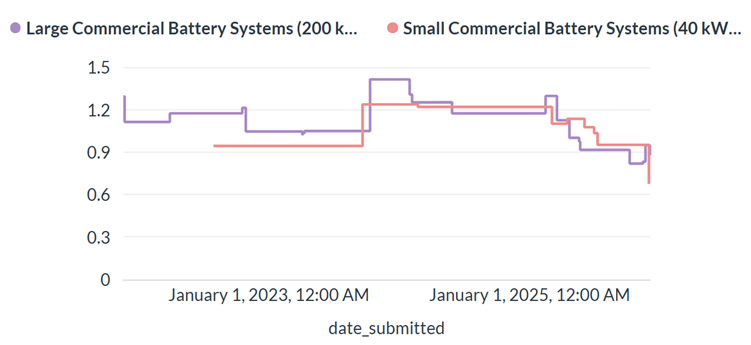
Battery supply and installation costs have fallen sharply through 2025. Industry pricing data now shows declines of around 20% on recent averages, with real-time project costs in some cases closer to 30% lower than a year ago.
When capital costs fall by a third, payback periods fall with them. Projects that once looked marginal are suddenly investable.
Small Batteries (Under 100 kWh)
For smaller commercial systems, the economics improve even further thanks to the Federal Government’s Cheaper Batteries Program.
When falling hardware costs are combined with this incentive, the installed price of a small battery today is close to half of what it was in 2024.
For businesses with existing solar or those considering installing it: This is where battery paybacks have started to look genuinely compelling.
Larger Batteries
Larger systems don’t receive an upfront subsidy, but they don’t need one in many cases.
Their scale allows them to participate more aggressively in wholesale markets, VPP programs and grid services where the revenue upside can be substantial.
In the right locations, with the right operating strategy, large batteries are increasingly being treated as revenue-generating assets rather than cost-saving equipment.
The Cheaper Batteries Program – Key Points
The Cheaper Batteries Program has been in effect since 1 July 2025, and is available to businesses of all sizes and industries.
The main conditions are straightforward:
- Total battery capacity must be 100 kWh or less per site
- The site must have solar installed (or install it alongside the battery)
- The incentive can only be claimed once per site
- The battery must be VPP-ready
- The system must be approved and installed by an accredited provider
- Off-grid systems more than 1 km from the grid are eligible
Why This Matters (And Where We’ll Go Next)
The combination of lower costs, stronger revenue streams and shrinking incentives has created a narrow but powerful window for businesses considering battery investments.
In the coming weeks, we’ll explore:
- Why many battery projects now make sense and debunking the myths of batteries
- And how large energy users are using batteries as both a hedge and operating as a financial assets with the right strategy.
All of this will lead into our upcoming webinar, where we’ll break down real-world battery economics, market opportunities and investment strategies in today’s energy environment.
Because batteries are no longer just about storing power.
They’re about timing, markets and turning volatility into value.
Be sure to register for our upcoming webinar going into all the details about commercial battery systems and how your business can benefit.
Our consultants provide independent assessments and connect you with trusted suppliers to secure compliant, cost-effective energy projects and savings. For the latest information or to speak to an expert at Sustainable Energy Solutions for a tailored conversation on your business’s needs and goals, please get in touch or call us on (02) 8044 0335.