
Every 1 July, electricity network tariffs are revised across Australia to reflect annual adjustments applied by local distribution networks.
While these changes often receive less attention than wholesale energy prices, they can have a material impact on total electricity costs for commercial and industrial energy users.
Network charges typically account for 30–50% of a commercial or industrial electricity bill. However, they are separate from retail electricity contracts and are not influenced by negotiated energy rates. Instead, they are set by local distribution networks such as Ausgrid, Energex, Endeavour Energy, CitiPower, Jemena and approved annually by the Australian Energy Regulator (AER). These costs are then passed through to end users regardless of their retail energy agreement.
From 1 July 2026, network costs will change again across all major distribution networks, with the magnitude of those changes varying considerably by jurisdiction, tariff class, and demand profile.
For energy-intensive businesses, this presents an opportunity to reassess whether they are still on the most optimal network tariff. In some cases, a tariff review can identify a meaningful cost savings.
Below is a summary of the approved network changes for large energy users from 1 July 2026:
| State / Territory | Network | Region | FY27 Change |
| NSW | Ausgrid | Inner Sydney, Central Coast, Hunter | +7.1% to +10.8% |
| NSW | Endeavour Energy | Western Sydney, Illawarra, South Coast | +9.8% to +12.5% |
| NSW | Essential Energy | Regional & Rural NSW | +9.2% to +11.8% |
| QLD | Energex | South East QLD (Brisbane, Gold Coast) | +12.1% to +13.1% |
| QLD | Ergon Energy | Regional, Rural & Northern QLD | +4.2% to +6.2% |
| VIC | CitiPower | Melbourne CBD & Inner Suburbs | +3.2% to +4.5% |
| VIC | Powercor | Western Victoria & Outer West Suburbs | +2.9% to +5.5% |
| VIC | United Energy | South-Eastern Melbourne & Mornington | +3.1% to +4.5% |
| VIC | Jemena | Northern & Inner-Western Melbourne | Decreasing |
| VIC | AusNet Services | Eastern Victoria & Outer East Suburbs | Decreasing |
| SA | SA Power Networks | Statewide South Australia | +1.2% to +2.4% |
| TAS | TasNetworks | Statewide Tasmania | +1.3% to +1.9% |
| ACT | Evoenergy | Canberra / ACT region | +11.5% to +12.8% |
| NT | Power and Water Corp | Darwin, Alice Springs, Katherine | +11.9% |
| WA | Western Power | South West Interconnected System | +3.5% to +6.5% |
Figures represent the approved average all-business network cost change for FY27. Actual impact varies by tariff class.
The ACT, Queensland’s south-east, and the Northern Territory face the steepest increases — all above 11%. Large businesses across NSW are looking at rises between roughly 7% and 13%. Victorian customers have a more mixed picture, with some networks actually reducing costs.
How Much Will This Impact Your Business?
Network charges typically account for 30–50% of a commercial or industrial electricity bill. An increase of 10% on the network component doesn’t look dramatic at first glance, but a constant increase almost every year can eventually become significant.
That cost lands on 1 July whether you’re ready for it or not. The question is whether you’re on the right tariff to avoid overpaying on your Network Costs.
Your electricity bill will show your network charges and in some cases your network tariff code. Check out our ‘Your electricity bill explained’ FAQs or get in touch with our energy experts if you’re unsure.
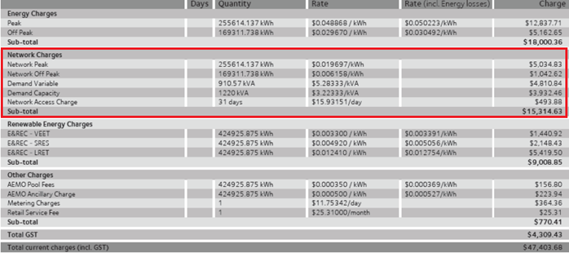
Your Business’s Network Tariff Might Have Changed
Here’s what many large energy users don’t know: the network tariff your site is assigned to isn’t fixed. It can be reviewed, and if your load profile, operational pattern, or on-site generation has changed since it was last assessed, you may be paying for a tariff structure that no longer fits.
This is what a Network Tariff Review (NTR) tests. It identifies whether a site is allocated to the correct and most beneficial tariff, or not.
The Commercial Case Is Well Established
The financial case for reviewing network tariff assignments is clearly documented. Industry data shows a meaningful proportion of large commercial and industrial sites would benefit from a tariff reclassification, with average savings running to several thousand dollars per site per year. At the portfolio level, across multi-site operations, the aggregate impact can be material.
For businesses that have made changes in recent years — added solar, shifted operating hours, upgraded equipment, changed production patterns — there is a possibility that your current tariff could be reviewed for an alternative and optimal tariff.
What You Should Do
If your business hasn’t had a formal Network Tariff Review in recent years, Sustainable Energy Solutions might be able to assist with one. If you want to understand what the FY27 changes mean for your specific sites, get in touch with our team.